
Fragile roof lights are among the least visible hazards on an industrial roof. This guide compares the main skylight protection options so facility teams can choose the right one for each roof light. Our fragile skylights page covers the hazard itself. Here, instead, we focus on comparing the options.
Written by: Yatin Chaudhary, TsaF. Last updated: 15 October 2026.
Skylight protection options: key takeaways
- Above all, every skylight needs a deliberate decision, not a default.
- In short, the four main options are framed mesh guards, flat-sheet mesh, barricades and routing with walkways.
- Framed mesh guards protect each roof light directly and keep most of the daylight.
- Routing alone is rarely enough where skylights sit near plant or gutters.
- Recheck protection after any roof works or skylight replacement.
Why skylight protection options need a deliberate choice
First of all, polycarbonate and fibre roof sheets lose strength as they age. In addition, dust and dirt hide them, so a skylight can look like solid roof. As a result, people step on them or lean on them while working nearby.
Because roofs differ so much, there is no single answer. For instance, a skylight next to a fan that technicians service every month needs different protection from one in a corner nobody visits. So the right approach is to look at each roof light, or each group, and choose deliberately.
Option 1: framed mesh guards
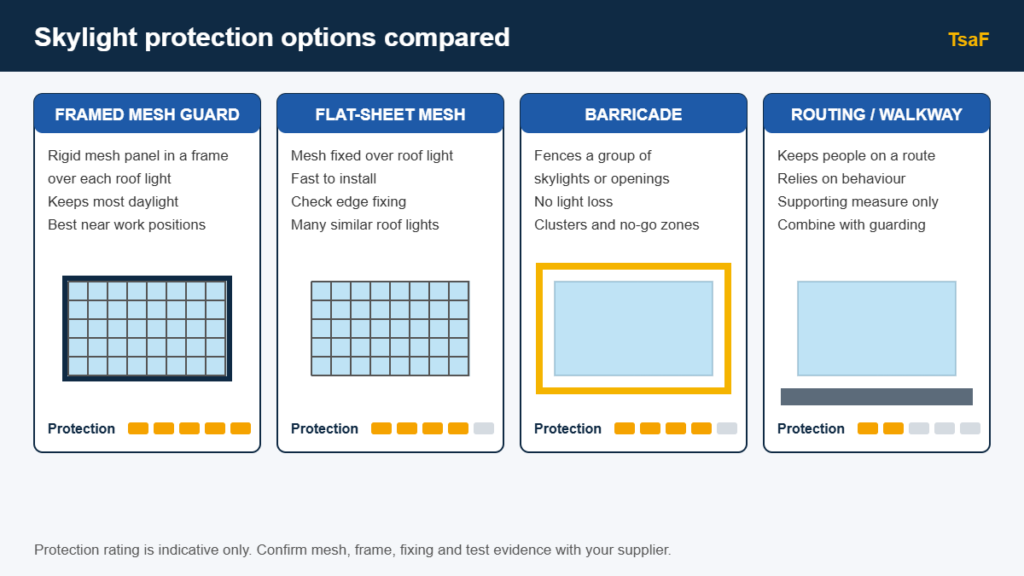
A framed mesh guard is a rigid mesh panel in a frame that sits over the roof light. In this way, it protects the skylight directly, so people can work nearby without changing routes. Moreover, mesh lets most of the daylight through.
Of course, fixing details depend on the roof. For example, guards fix differently to trapezoidal and standing seam roofs, and some designs allow height adjustment. Before buying, confirm the mesh, the frame material and the fixing with your supplier, and ask for test evidence. Also think about cleaning: the guard should not stop anyone from cleaning or maintaining the skylight. See framed guards on our system page for roof lights.
Option 2: flat-sheet mesh
Flat-sheet mesh is a simpler option that installs quickly over the skylight. Specifically, it suits roofs with many similar roof lights where speed matters. However, it may offer less adjustment for different roof profiles, and you must check its fixing carefully. In particular, confirm how the fixings hold the mesh at every edge.
Option 3: barricades around skylights
In some cases, however, it is better to fence off a group of skylights than to cover each one. For example, a cluster of roof lights in an area nobody needs to enter can sit behind a single barricade. Similarly, barricades can guard roof openings and voids. Our guide to rooftop barricade design explains the layout factors.
Option 4: routing and walkways
Alternatively, walkways and signage keep people on a defined route away from skylights. As a result, this reduces exposure and also protects the roof sheet. Nevertheless, routing alone is rarely enough where skylights sit close to plant, gutters or other work positions. In those places, people inevitably leave the walkway. For walkway options, see aluminium vs FRP rooftop walkways.
Comparing skylight protection options
The table below summarises how the options compare. First, use it as a starting point, then confirm the choice during a site survey.
| Option | Protection level | Cost drivers | Light loss | Maintenance | Best use |
|---|---|---|---|---|---|
| Framed mesh guard | High, at each skylight | Number and size of roof lights, roof profile | Low | Check fixings and frame | Skylights near work positions |
| Flat-sheet mesh | Good, depends on fixing | Number of roof lights | Low | Check edges and fixings | Many similar roof lights |
| Barricade | High, for a whole zone | Length of barricade, gates | None | Check posts and rails | Clusters of skylights, no-go zones |
| Routing and walkways | Lower, relies on behaviour | Walkway length | None | Check surface and signage | Supporting measure only |
On standards, ask each supplier which standard their skylight guard was tested to, and ask to see the report. After all, a claim without evidence should not decide your choice.
Inspecting skylight protection options once installed
To begin with, inspect mesh panels, fixings, frames and seals at least once a year. In addition, carry out extra checks after roof works, re-sheeting or skylight replacement, because contractors often remove guards and refit them poorly. TsaF’s Annual Maintenance Check records these points.
Sources and further reading
- HSE (UK): Roof work and fragile surfaces.
- OSHA (US): Fall protection.
- Site assessment checklist for EHS and facility teams.
Frequently asked questions
Where people work near a skylight, a framed mesh guard over the roof light usually gives the most direct protection while keeping most of the daylight. Groups of skylights in no-go areas can sit behind a barricade instead.
Walkways reduce exposure, but routing alone is rarely enough where skylights sit near plant, gutters or work positions, because people leave the walkway to do their tasks.
Mesh guards let most of the daylight through. Barricades and walkways do not affect light at all.
At least once a year, and again after any roof works, re-sheeting or skylight replacement, because guards are often removed and refitted during that work.
Ask about the mesh and frame material, the fixing for your roof profile, the standard the guard was tested to, and for the test report.
Next step: assess your skylight protection options
Choosing between skylight protection options is easier with a survey of every roof light. Request a site assessment and a TsaF engineer will assess your skylights and recommend protection for each one.

