
Rooftop solar has made industrial roofs in India far busier. A roof that was once visited a few times a year now sees module cleaning crews and O&M technicians every few weeks, often working close to roof edges and fragile roof lights. This guide explains how to plan fall protection for rooftop solar, before installation and as a retrofit. It is written by TsaF, part of MT&T Group, which designs, manufactures and installs fall protection systems for industrial roofs from its facility in Jewar, Uttar Pradesh.
Written by: Yatin Chaudhary, TsaF.
Why do solar roofs need planned fall protection?
Short answer: solar arrays bring people onto the roof far more often, for cleaning, inspection and repairs, and they reduce the free space people can walk in. That pushes workers closer to roof edges, skylights and translucent sheets, on surfaces that are often wet from cleaning. Fall protection should be designed around these routes and tasks, ideally before the modules are installed.
The hazards on a solar roof
| Hazard | Why it is worse on a solar roof |
|---|---|
| Unprotected roof edges | Outer array rows are often close to the edge, and cleaning them means working at the perimeter. |
| Fragile roof lights and translucent sheets | Arrays shade and hide them, so they are easier to step on by mistake. |
| Slippery surfaces | Water-based module cleaning leaves sheets and walkways wet, and dust adds to the slip risk. |
| Reduced walking space | As more panels cover a roof, routes narrow and pass closer to openings and hatches. |
| Frequency of access | Cleaning cycles, especially in dusty regions during the dry season, mean many more visits than on a plain roof. |
| Access points | Ladders and hatches carry more traffic, often with people carrying tools and cleaning equipment. |
The US Occupational Safety and Health Administration notes the same pattern for solar work: as panels cover more of a roof, walkway space shrinks and workers are forced closer to skylights and roof hatches. Its guidance calls for guarding skylights or using personal fall protection near them.
Plan before the array goes in
The most effective point to plan fall protection is during solar design, before the module layout is fixed. At that stage you can:
- reserve clear routes from the access point to every row, inverter and junction box;
- keep a strip along the roof edge for a horizontal life line system or barricade;
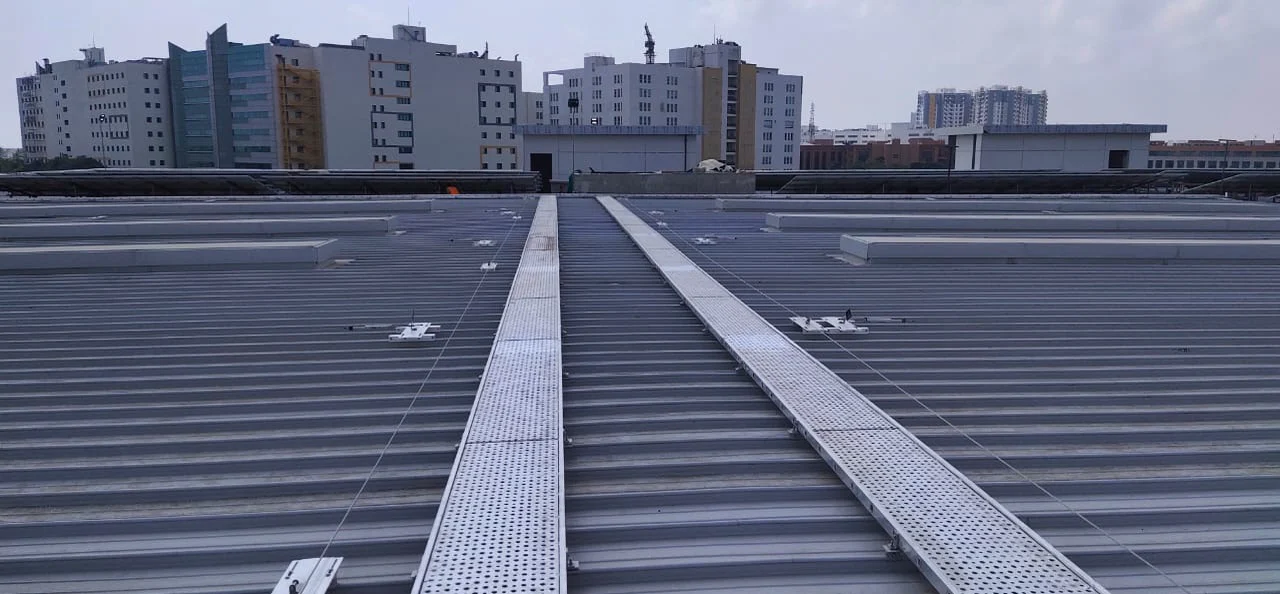
- place walkways between rows so that cleaners never stand on the roof sheet;
- cover roof lights with skylight protection before modules shade them;
- confirm that lifeline and walkway fixings suit the roof sheet and do not clash with module mounting rails.
Retrofitting is possible, but existing rows can restrict where lifelines and walkways go, and some modules may need temporary removal.
Recommended layout: walkways, lifelines and protected roof lights
Most industrial solar roofs are best served by combining systems:
- Safe access: a caged ladder or stair, with a vertical life line system on tall ladders and a safe landing at the top.
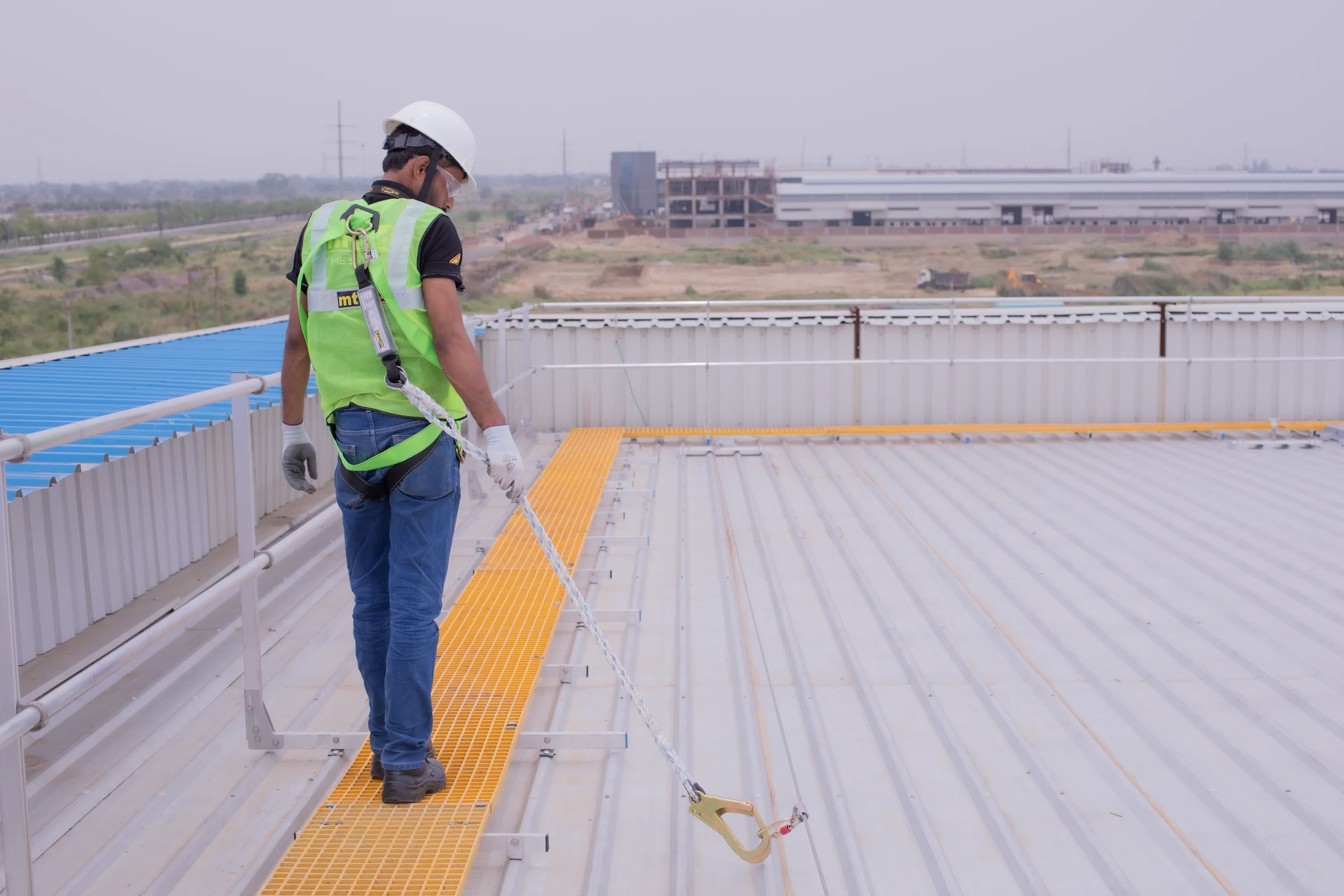
- Walkways between rows: an aluminium or FRP walkway gives a slip-resistant route and protects the sheet. Non-penetrating clamps suit standing-seam roofs, and sealed fixings suit trapezoidal sheeting.
- Edge protection: rooftop barricades where the perimeter can be guarded; a horizontal life line system where it cannot. TsaF’s horizontal lifeline uses Ø8 mm SS 316L cable with pass-through trolleys, so cleaners stay connected while they move along the rows.
- Roof lights: galvanised mesh guards over every skylight and translucent sheet near the array.
- Rescue: an anchorline and rescue system and a written plan for recovering anyone suspended after a fall.
Low-pitch roofs still need protection
Many solar roofs are nearly flat, which can make the edge feel safe. It is not. A trip or slip on a wet, dusty sheet near an unprotected edge can still lead to a fall. Where barricades are not practical along the full edge, a horizontal lifeline in restraint configuration stops workers reaching the edge at all.
Who is responsible on a solar roof?
Several parties are usually involved: the building owner, the solar EPC contractor during installation and an O&M or cleaning contractor afterwards. Fall protection works best when responsibilities are agreed in writing:
| Stage | Typical responsibility |
|---|---|
| Solar design | Owner and EPC agree routes, edge zones and walkway positions |
| Installation | EPC provides fall protection for its crews during construction |
| Permanent systems | Owner provides lifelines, walkways and skylight protection for long-term O&M |
| Cleaning and O&M | Contractor trains its workers to use the systems and follows the rescue plan |
| Inspection | Owner arranges periodic inspection of the permanent systems |
Inspection and maintenance
- Users check lifelines, connectors and harnesses before each use.
- A competent person inspects lifelines, walkways and skylight guards at least annually. TsaF’s annual maintenance check covers these systems.
- Review the layout whenever modules are added or re-arranged, or roof sheets are replaced.
- After any fall, take the system out of service until it has been inspected.
Frequently asked questions
Should fall protection be installed before or after the solar panels?
Before, where possible. Planning lifelines and walkways with the module layout keeps routes and edge zones clear. Retrofits are feasible but can be constrained by existing rows.
Can walkways be installed between solar rows?
Yes, where row spacing allows. Non-penetrating clamps suit standing-seam roofs, and sealed fixings suit trapezoidal sheeting.
Do solar cleaners need harnesses?
Wherever they can reach an unprotected edge or fragile roof light, they need either collective protection, such as barricades and skylight guards, or a harness connected to a lifeline. Collective protection is preferred where it is practical.
Is a flat solar roof safe without edge protection?
No. Wet and dusty surfaces make slips likely even on low-pitch roofs, and a slip near an edge can become a fall.
Can one lifeline serve several solar blocks?
It can, if the layout is designed for it. Corners, intermediate brackets and the number of simultaneous users are set during design.
Next step
Whether your array is in design or already installed, start with a roof survey. Explore TsaF’s fall protection systems in India, see our renewable energy solutions, or request a rooftop assessment.
Sources and references
- US Occupational Safety and Health Administration, Green Job Hazards: Solar Energy, Falls
- TsaF, Fall protection for renewable energy
- TsaF, Horizontal Life Line System and Aluminium & FRP Walkway System: specifications

