
Before you order an overhead life line system, answer ten questions: how long the work area is, how high the line will be, how much clearance there is below the worker, whether a trolley or a retractable arrestor suits the task, how many people will use it, what it will be fixed to, the environment, the rescue plan, the standards your client specifies and how it will be inspected. Settling these first gives you an accurate quotation and a line that suits the way your site works. This checklist explains each question.
Written by: Yatin Chaudhary, TsaF. Last updated: 22 October 2026.
Key takeaways
- An overhead life line system anchors the worker from above, for work on vehicles, tankers, wagons and equipment.
- Fall clearance below the worker decides whether a trolley lanyard or a retractable arrestor is used.
- Outdoors, a dedicated support structure can be designed if there is no building to fix to.
- Every overhead line needs a rescue plan, trained rescuers and the right equipment on site.
- TsaF overhead lifelines are designed in accordance with EN 795:2012 Class C, CEN/TS 16415:2013 and IS 3521 Part 8:2021.
What is an overhead life line system?
An overhead life line system is a horizontal cable fixed above a work area, so the anchor is over the worker’s head rather than at their feet. Workers connect through a pass-through trolley or a 10 m retractable fall arrestor and move along the vehicle or equipment without unclipping. It suits loading bays, tanker and truck tops, rail wagons and machinery, where there is often nothing to anchor to at foot level.
When should you choose overhead instead of horizontal?
Choose an overhead lifeline for work on top of vehicles, equipment or machinery, where the anchor needs to be above the worker. Choose a horizontal life line system for roofs, where the line runs along the roof surface. Many sites need both, and TsaF assesses which fits each work area.
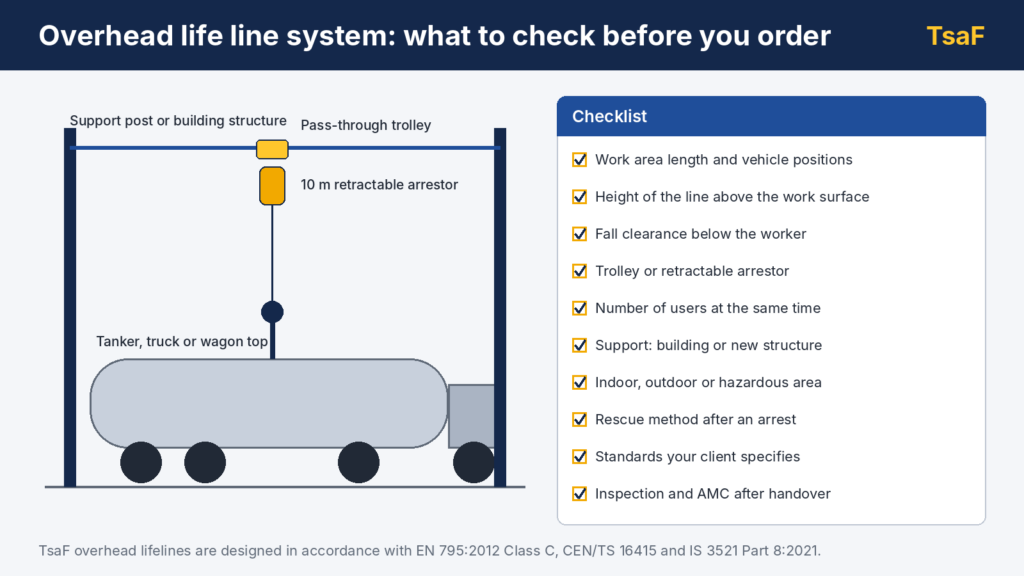
The 10 questions to answer before you order
1. How long is the work area, and where do vehicles stop?
The line must cover every position a worker reaches, including different vehicle lengths and stopping points. Measure the full working length, not just one vehicle.
2. How high will the line be above the work surface?
The height of the line above the vehicle top affects the connecting equipment and how far a worker can move to either side.
3. How much clearance is there below the worker?
Clearance is the distance needed to stop a fall before the worker strikes the vehicle side or the ground. It is checked at design stage and decides the connecting device.
4. Trolley lanyard or retractable arrestor?
| Option | Suits | Note |
|---|---|---|
| Pass-through trolley | Workers moving along the line | Passes intermediate brackets without unclipping |
| 10 m retractable arrestor | Low clearance and wide side-to-side movement | Locks quickly, keeping the fall distance short |
5. How many people will use the line at the same time?
The line, supports and end anchors are designed for a set number of users. Tell the designer the maximum number of people on vehicle tops at once.
6. What will the line be fixed to?
Indoors, the line is usually fixed to the building structure. Outdoors, TsaF can design a dedicated support structure. Where neither is practical, a freestanding mobile anchor such as TruckSafe or ConcreteSafe may suit better.
7. Is the area indoor, outdoor or hazardous?
Weather, corrosion and site classification affect materials and components. Tell the designer about fuel, chemical or dusty environments at the start.
8. How will a worker be rescued after a fall?
After an arrested fall, the worker is held by the arrestor and must be lowered or rescued promptly. Plan the rescue method, trained rescuers and equipment before the line goes into use. Our rescue planning guide explains the options.
9. Which standards does your client specify?
TsaF overhead lifelines are designed in accordance with EN 795:2012 Class C, CEN/TS 16415:2013 and IS 3521 Part 8:2021. Check these against your client’s specification, and see our explainers on EN 795 and IS 3521 Part 8.
10. Who will inspect the line after handover?
Users check the trolley and arrestor before each use, and TsaF recommends a formal inspection at least once a year. The Annual Maintenance Check covers the cable along the full path, trolley movement, suspension brackets, end stops, trolley retention, clearance and wear on connection hardware.
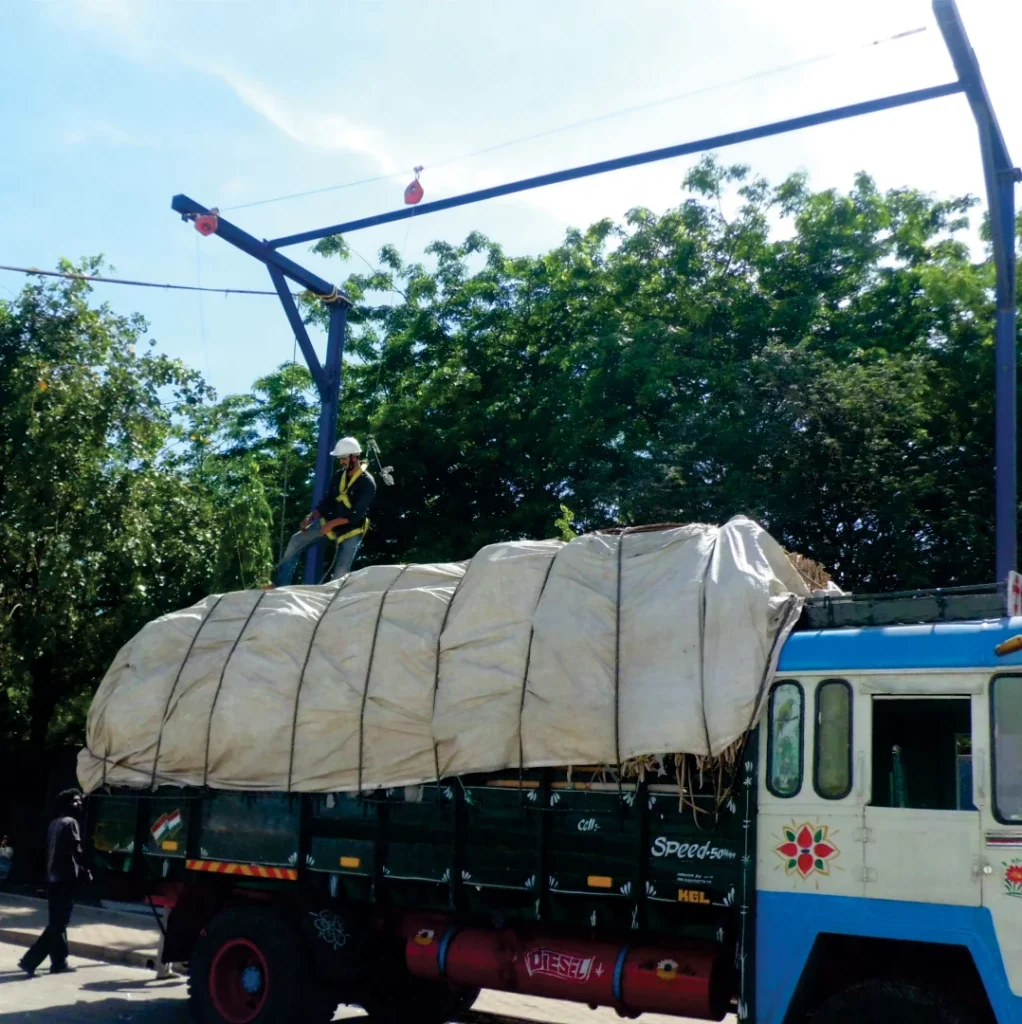
What should you send TsaF for a quotation?
- A plan or sketch of the work area with dimensions and vehicle positions.
- The height available above the vehicle tops.
- Photos of the building structure or the open area.
- The number of workers on vehicle tops at once.
- Your client’s standards and any site rules.
For loading-bay planning in more depth, read our guide to overhead lifelines for loading bays and vehicle tops.
Frequently asked questions
Check the work area length, line height, fall clearance, trolley or retractable arrestor, number of users, support structure, environment, rescue plan, client standards and the inspection plan after handover.
No. Indoors it is usually fixed to the building structure. Outdoors, TsaF can design a dedicated support structure, or a freestanding mobile anchor may suit better.
A retractable arrestor suits low clearance and wide side-to-side movement, because it locks quickly and keeps the fall distance short. The design check confirms which device applies.
TsaF designs it in accordance with EN 795:2012 Class C, CEN/TS 16415:2013 and IS 3521 Part 8:2021. Refer to the product datasheet for each component.
Users check the trolley and arrestor before each use, and TsaF recommends a formal inspection at least once a year.
TsaF designs, manufactures, installs and maintains each overhead life line system, including support structures where needed. Request a site assessment for your loading area.

