
An overhead lifeline lets people work on top of trucks, tankers and wagons while staying connected to an anchor above them. This guide helps operations and engineering teams plan an overhead lifeline for loading bays, tanker filling points and other vehicle-top work. It focuses on selection and planning decisions. For the hazard itself, see our page on vehicle tops and loading bays.
Written by: Yatin Chaudhary, TsaF. Last updated: 15 October 2026.
Overhead lifeline planning: key takeaways
- Choose an overhead lifeline when people must stand on a vehicle top and edge protection is not possible.
- Map the work zone first: vehicle positions, heights, users and obstructions.
- Confirm the support structure and load path before you choose components.
- Fall clearance on vehicle tops is tight, so retractable fall arresters and overhead attachment matter.
- Plan rescue from the vehicle top before the line goes into use.
When an overhead lifeline is the right choice
An overhead lifeline suits tasks that put people on top of trucks, tankers, wagons or large equipment. In these places, guardrails are usually impractical because the vehicle moves in and out. So the protection has to travel with the worker.
However, it is not the only option. A fixed gantry or loading platform can remove the fall hazard altogether where vehicles always stop in the same spot. Similarly, mobile anchors such as TruckSafe or ConcreteSafe suit sites with no overhead structure or with changing work locations. Where possible, a restraint arrangement that stops the worker reaching the edge is better than one that arrests a fall.
Mapping the work zone
Good overhead lifeline design starts with an accurate picture of the bay. First, record vehicle positions, lengths and heights, and where people climb on and off. Next, count how many people use each bay at the same time, and how many bays need cover.
Then look up and around. Cranes, pipe racks, lighting and other overhead services all constrain where the line can run. Also note whether the line will be indoors or outdoors, because this affects material choice and inspection frequency. Finally, consider vehicle and pedestrian traffic so that the line does not create a new hazard.
Support structure and overhead lifeline layout
An overhead lifeline needs a structure strong enough to carry fall arrest loads. In many warehouses, the line fixes to existing portal frames. Elsewhere, new support columns or goalposts carry it. In both cases, a structural engineer should check the load path from the line into the foundations.
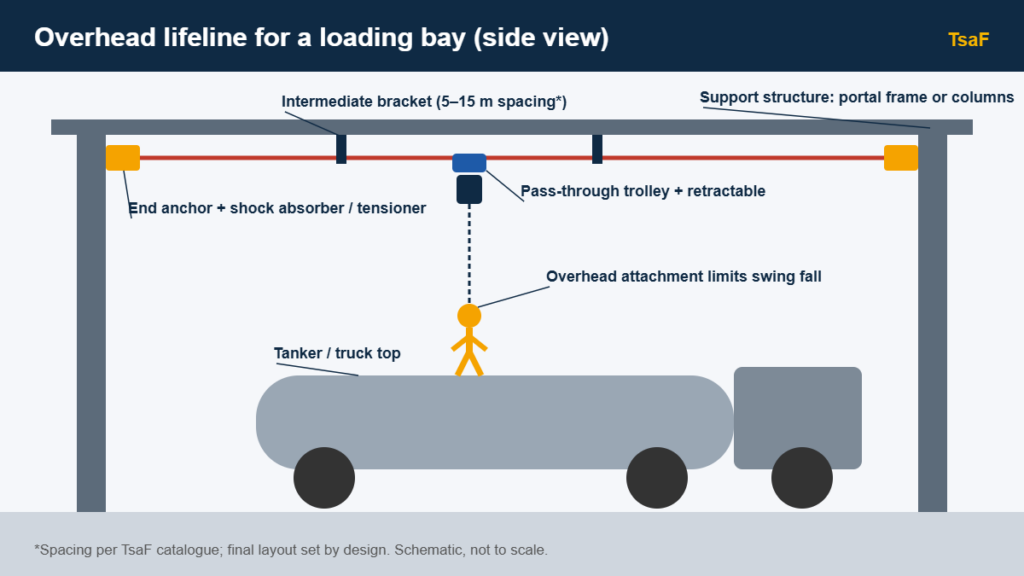
Along the line, intermediate brackets support the cable. TsaF’s catalogue lists intermediate spacing of 5 to 15 m, depending on the design. At each end, an end anchor with a shock absorber and tensioner limits the force on the structure and keeps the cable taut. For multiple bays, designers choose between one long straight run and several parallel lines. You can review component options on our system page for loading bays.
Trolleys, retractables and connection
The worker connects to the line through a trolley. Pass-through trolleys glide over intermediate brackets, so the worker stays connected along the whole run. Non-pass-through trolleys suit short lines between two anchors. Single- and double-wheel types also differ in how smoothly they travel.
In addition, most vehicle-top systems use a retractable fall arrester between the trolley and the harness. The retractable keeps the line short and taut as the worker moves. As a result, free fall distance stays small. Keeping the attachment point directly overhead also reduces the risk of a swing fall.
Clearance and swing fall on vehicle tops
Vehicle tops are often only a few metres above the ground. Therefore, there is little room for a fall to be arrested before the worker strikes the ground or the vehicle side. Clearance must be calculated for each layout, taking into account the line, the retractable and the worker’s position.
Swing falls are the second concern. When a worker moves towards the end of a long tanker, the line may no longer be overhead. If they fall, they swing sideways into the vehicle or nearby structures. For this reason, good layouts limit lateral movement and keep work positions within the zone the line protects.
Rescue and operational fit
A fall from a vehicle top leaves the worker suspended beside a tanker or truck. Rescue must be quick. So keep rescue equipment at the bay, and make sure trained people are available on every shift. Our guide to rescue planning for work at height covers this in detail.
Procedures matter just as much. Decide who connects, at what point, and how drivers and loaders are trained. Also make sure contractors’ drivers follow the same rules as your own staff.
Inspecting an overhead lifeline
Users should check the trolley, connectors and retractable before each use. In addition, a competent person should inspect trolleys, end stops, brackets, the shock absorber and clearances at least once a year. TsaF’s Annual Maintenance Check covers these points and records them for audits.
Sources and further reading
- HSE (UK): Work at height guidance.
- OSHA (US): Fall protection.
- Horizontal lifeline systems: design and components.
Frequently asked questions
Use one when people must stand on top of trucks, tankers or wagons and guardrails are impractical because vehicles move in and out. Where vehicles always stop in one place, a fixed gantry or platform may be better.
Often yes, if a structural check confirms that the portal frames can carry the fall arrest loads. Otherwise, new support columns or goalposts carry the line.
A retractable keeps the connection short and taut as the worker moves, which limits free fall distance. This matters on vehicle tops, where clearance to the ground is small.
It depends on the design: span, bracket spacing, end anchors and structure. The permitted number of users is stated in the handover documents and must not be exceeded.
Users should check trolleys, connectors and retractables before each use, and a competent person should inspect the full system at least once a year.
Next step
Every loading bay is different, so the right overhead lifeline starts with a bay-by-bay review. Request a site assessment and a TsaF engineer will map your vehicles, users and structure.

