Fixed ladder fall protection starts with an honest look at the ladder itself. Fixed ladders are often the only way onto a roof, tank or platform. However, many were installed decades ago without fall protection in mind. This guide sets out what to assess before you choose a protection measure. For the hazard itself, see our page on ladders and vertical climbs.
Written by: Yatin Chaudhary, TsaF. Last updated: 15 October 2026.
Fixed ladder fall protection: key takeaways
- Check the ladder’s structure first. Protection added to a failing ladder does not make it safe.
- Climb height, frequency of use and what climbers carry all shape the choice.
- A cage is not fall arrest. A vertical lifeline is.
- The top exit and landings are where many falls happen, so assess them too.
- Sometimes replacing the ladder is better value than retrofitting it.
Assess the ladder before adding fixed ladder fall protection
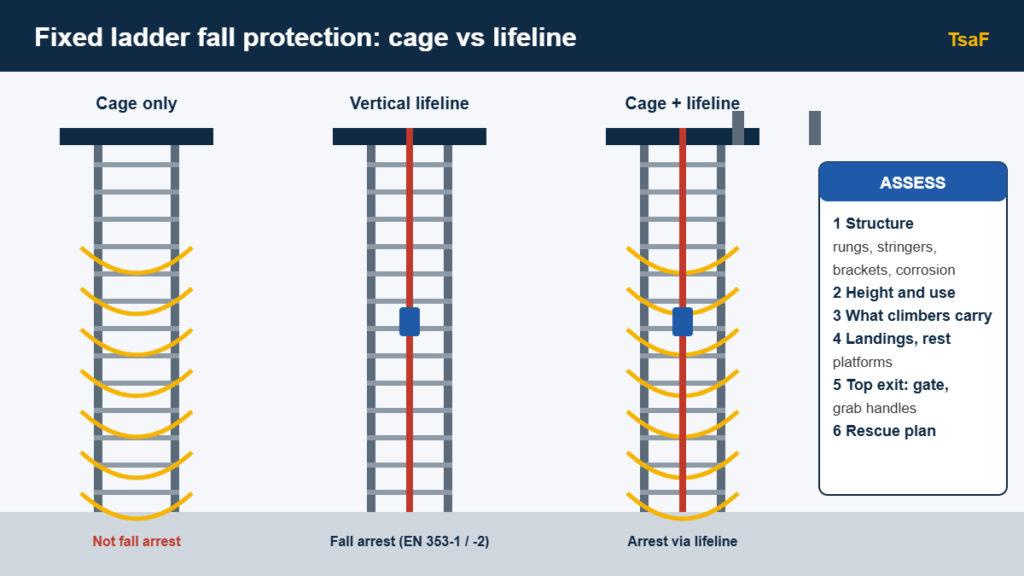
Start with the structure. First, check the stringers, rungs and brackets, and how the ladder fixes to the building or tank. Then look for corrosion, damage and misalignment. In particular, check welds and fixings near the base, where water collects.
If the ladder itself is weak, repair or replacement must come first. After all, a lifeline anchored to a corroded ladder is only as strong as that ladder.
Height, use and users
Next, record how high the climb is and how often people use it. For example, a ladder that a technician climbs daily needs more robust protection than one used twice a year. Also note what climbers carry. Tools and parts make it harder to keep three points of contact. As a result, a climber with a load is more likely to slip.
Cage, lifeline or both?
Many older ladders have a cage. A cage gives climbers a sense of security, and it may stop someone from leaning backwards. However, a cage is not fall arrest. A falling person can slide down inside it and strike the hoops, the rungs or the ground.
In contrast, a vertical lifeline connects the climber to the ladder through a guided fall arrester that locks if they fall. There are two main types. Rail-type systems use a rigid anchor line and relate to EN 353-1. Rope-type systems use a flexible anchor line and relate to EN 353-2. Our article on rope vs rail vertical lifelines compares them in detail, and you can see options on our vertical lifeline system page.
Landings, rest platforms and the top exit
Long climbs tire people. Therefore, rest platforms at intervals let climbers pause safely. The top exit needs equal attention. Many falls happen at the moment someone steps off the ladder onto a roof or platform. So check for extended stiles or grab handles, a safe step-off area and a self-closing gate.
Finally, think about what happens next. Ideally, the climber stays connected from the ladder to the roof system, such as a horizontal lifeline, without a gap in protection.
Fixed ladder fall protection: replacement options
Sometimes the best fixed ladder fall protection is a new ladder. For instance, when a ladder is badly corroded or in the wrong position, retrofitting can cost more than replacing it. TsaF supplies aluminium cage ladder systems, which you can combine with a vertical lifeline. TsaF also offers the Flowlok ladder system; contact us for current specifications.
In short, compare the full cost of repair plus protection against a new ladder with protection built in.
Training, rescue and inspection
Climbers need training in how to connect, climb and disconnect. In addition, plan how you would rescue someone who falls and is suspended on a ladder. Our guide to rescue planning for work at height explains how.
For inspection, check rungs, cage hoops, brackets, platforms and the entry and exit sections. Also check the lifeline, fall arrester and labels. TsaF’s Annual Maintenance Check covers these points every year.
Sources and further reading
- OSHA 1910.28: Duty to have fall protection.
- HSE (UK): Work at height guidance.
- EN 353-1 vs EN 353-2 explained.
Frequently asked questions
No. A cage may stop someone leaning backwards, but it does not arrest a fall. A falling climber can slide down inside the cage. A vertical lifeline with a guided fall arrester provides fall arrest.
Rail-type systems use a rigid anchor line and relate to EN 353-1. Rope-type systems use a flexible anchor line and relate to EN 353-2. Both use a guided fall arrester that locks in a fall.
Often yes, but only after checking the ladder structure. If the ladder is corroded or weak, repair or replace it first, because the lifeline relies on it.
Many falls happen while stepping off the ladder onto a roof or platform. Extended stiles or grab handles, a safe step-off area and a self-closing gate reduce that risk.
Users should check the ladder and their fall arrester before each climb, and a competent person should inspect the ladder, cage, platforms and lifeline at least once a year.
Next step for fixed ladder fall protection
A quick survey of each ladder shows whether to protect, repair or replace it. Request a site assessment and a TsaF engineer will assess your fixed ladders and their exits.