
Aircraft maintenance puts technicians on top of fuselages, wings and stabilisers: curved, often slippery surfaces with no anchor points of their own. In a hangar, the practical answer is to anchor from above. This guide explains how overhead life line systems protect technicians working on aircraft, what to consider when designing one for a hangar and how the rest of the hangar’s work at height fits around it. It is written by TsaF, part of MT&T Group, which designs, manufactures and installs fall protection systems in India.
Written by: Yatin Chaudhary, TsaF.
How does fall protection work over an aircraft?
Short answer: a cable lifeline is suspended from the hangar structure above the aircraft. The technician connects to it through a trolley and, usually, a retractable fall arrestor, so the anchor follows them along the wing or fuselage. If they slip, the arrestor locks quickly and limits the fall. The layout is designed around the aircraft types, tail heights and overhead equipment in that hangar.
Work at height in a hangar
| Area | Typical tasks | Main hazard |
|---|---|---|
| Fuselage top | Inspections, antenna and sensor checks, panel removal, cleaning | Curved surface, no anchor points |
| Wings and stabilisers | Inspections, panel work, de-icing equipment checks | Slippery surfaces, edges on every side |
| Engines and nacelles | Access from stands and platforms | Gaps between stand and aircraft |
| Hangar roof | Roof, ventilator, drainage and roof-light maintenance | Long spans, translucent sheets, wind |
| Hangar doors and gantries | Door track and gantry maintenance | Tall fixed ladders, often unprotected |
Why overhead anchorage suits aircraft work
- Nothing to anchor to at foot level. The airframe must not be used as an anchor.
- Less free fall. An anchor above the worker reduces the distance fallen before the system acts, which matters when the drop is onto a wing, stand or hangar floor.
- Freedom to move. A trolley on an overhead line follows the technician along the aircraft, so they do not need to unclip.
- Clear floor space. Equipment hangs from the structure, leaving the hangar floor free for aircraft movements and ground equipment.
Choosing the trolley and connection
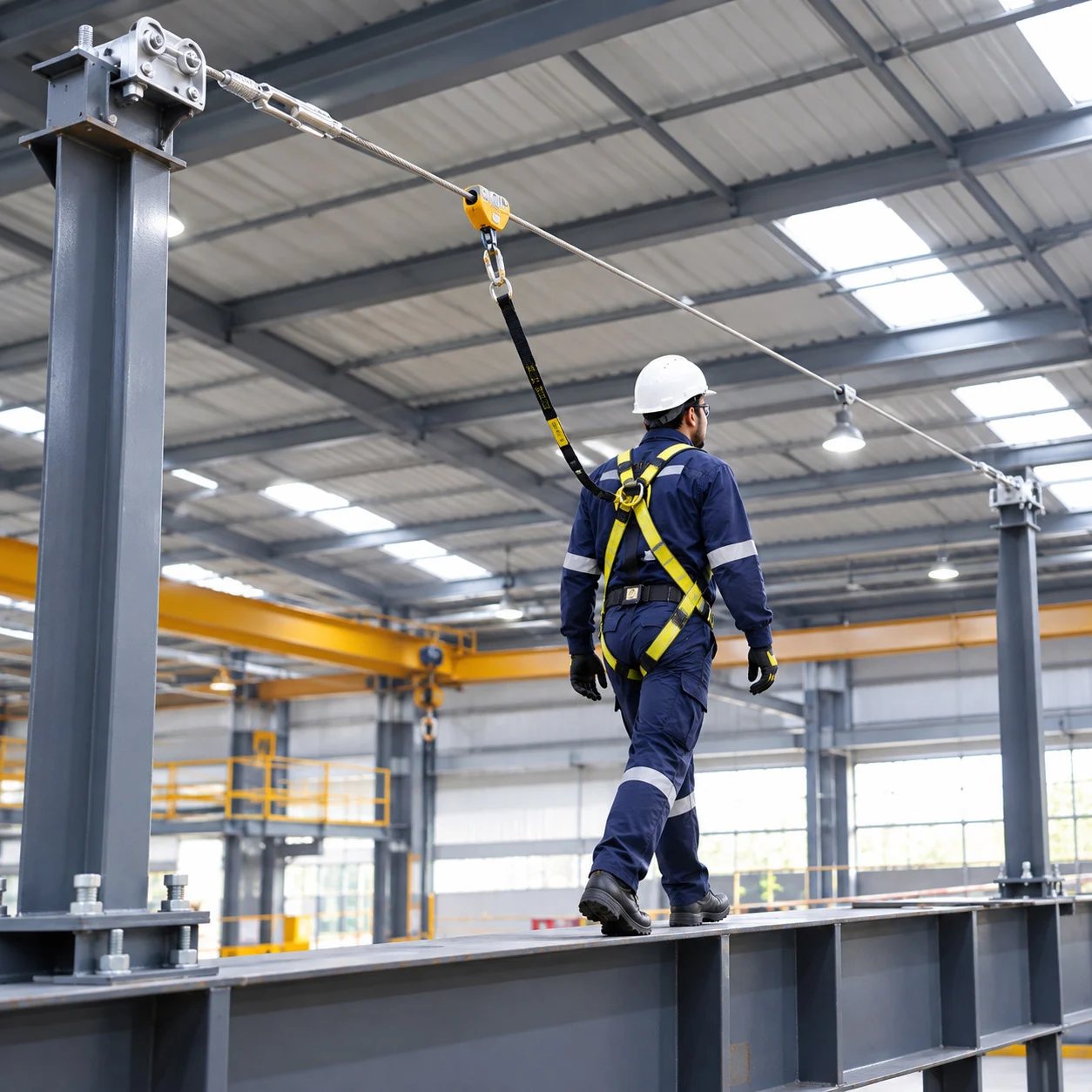
The TsaF overhead life line system uses Ø8 mm SS-316 7×7 wire rope with intermediate brackets typically every 5 to 15 m on long lines. Several trolley and connection options are available:
| Component | Type | Rated strength | Typical use |
|---|---|---|---|
| TSAF-407 | Double-wheel pass-through trolley (SS-304) | 15 kN | Long lines with intermediate brackets, where the worker moves past supports |
| TSAF-406 | Double-wheel non-pass-through trolley (anodised aluminium alloy) | 15 kN | Lines where the worker does not need to pass intermediate supports |
| TSAF-408 | Single-wheel non-pass-through trolley (SS-304) | 15 kN | Lines where the worker does not need to pass supports; compact single-wheel design |
| TSAF-404 | Retractable fall arrestor, 10 m | See datasheet | Keeps slack to a minimum and arrests a fall quickly |
The right combination depends on the aircraft, the line layout and the fall clearance available below the technician.
Design inputs for a hangar lifeline
A hangar lifeline is engineered for that hangar. The main inputs are:
- Aircraft types and tail heights that will use the bay, now and in the near future.
- Hangar truss capacity, confirmed by structural review, because the lifeline loads go into the roof steel.
- Clearances from cranes, lighting, fire systems and door mechanisms.
- Fall clearance below the technician on each part of the aircraft.
- Number of users working at the same time.
- Rescue method for a technician suspended above the airframe.
One line can serve several aircraft types if its layout is designed for that range. Very different aircraft sizes may need more than one line or separate bays.
Fall clearance over wings and stands
Clearance is often the deciding factor. A technician arrested above a wing must stop before striking the wing, a stand or the floor. Overhead anchorage and a retractable arrestor both reduce the distance fallen, but each layout must be checked against the actual heights. See our explainer on anchorage and fall clearance for the variables involved.
Rescue above an aircraft
A technician held in a harness above an aircraft must be recovered quickly, without improvised access across the airframe. Plan the rescue method, equipment and trained people when the system is designed. Rescue davits and mobile anchors are part of TsaF’s anchorline and rescue system. See also rescue planning for work at height.
The rest of the hangar
- Hangar roofs: a horizontal life line system, walkways and skylight protection over translucent sheets. Hangar roofs are larger, higher and windier than typical industrial roofs, so bracket spacing and access points need careful planning.
- Door and gantry ladders: a vertical life line system on tall fixed ladders.
Installing in an operating hangar
Installation is scheduled around aircraft movements. Work areas are agreed with hangar operations, and foreign object debris is controlled throughout, so that installation does not put aircraft or maintenance schedules at risk.
Frequently asked questions
Can technicians anchor to the aircraft?
No. Airframes are not designed as fall protection anchors. Anchorage should come from the hangar structure or a dedicated support frame.
Can one overhead lifeline serve different aircraft?
Yes, if it is designed for the range of aircraft. Widely different sizes may need multiple lines or separate bays.
What happens after a fall is arrested?
The technician must be rescued promptly using the planned method. The system is then taken out of service and inspected, and any deployed components are replaced before reuse.
Which standards apply?
TsaF’s overhead lifeline is designed in accordance with EN 795:2012 Class C, CEN/TS 16415:2013 and IS 3521 Part 8:2021. Applicable standards depend on the configuration and components selected.
How often should a hangar lifeline be inspected?
Users check it before each use, and a competent person inspects it at least annually, or more often where use is heavy.
Next step
Every hangar and fleet mix is different, so design starts with a survey of the bay and the aircraft. See our aviation and hangar solutions, explore TsaF’s fall protection systems in India, or request a hangar assessment.
Sources and references
- TsaF, Overhead Life Line System: specifications, trolley types and standards
- TsaF, Fall protection for aviation and hangars
- TsaF, Certifications: EN 795:2012 / CEN/TS 16415:2013 test certificates

