
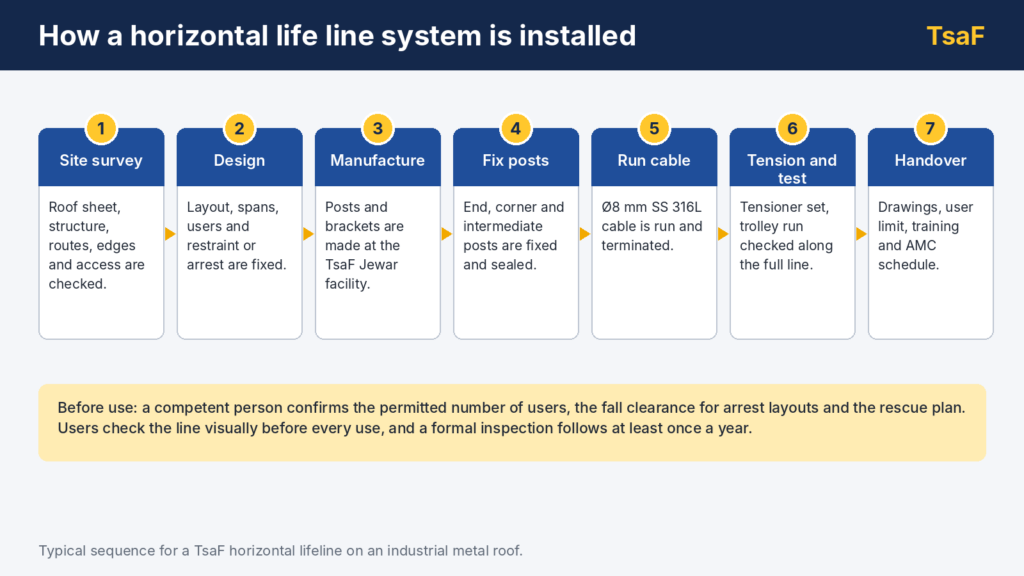
A horizontal life line system is installed in seven stages: site survey, design, manufacture, fixing the posts, running and terminating the cable, tensioning and testing, and handover with training. Each stage has a check that the next one depends on, so skipping or rushing one can leave a line that looks complete but does not perform as designed. This guide walks through each stage as TsaF carries it out on industrial metal roofs, and lists what you should receive at handover.
Written by: Yatin Chaudhary, TsaF. Last updated: 22 October 2026.
Key takeaways
- Installation starts with a site survey and a design, not with drilling the roof.
- Fixings are chosen for the roof sheet: screw-down for trapezoidal roofs, clamp-on for standing seam roofs.
- The cable must be tensioned correctly and the trolley tested along the full route before use.
- At handover you should receive drawings, the permitted number of users, labels and user training.
- The line needs a visual check before every use and a formal inspection at least once a year.
What is installed in a horizontal life line system?
A horizontal life line system has five main parts: end anchors that terminate the line, a Ø8 mm SS AISI 316L 7×7 cable, a shock absorber cum tensioner, intermediate and corner brackets on roof posts, and a travelling trolley that connects the worker. On TsaF systems the SS-304 Glider-8 trolley passes through intermediate and corner brackets automatically, so the worker never unclips.
Step 1: What happens during the site survey?
A TsaF engineer walks the roof and records the roof sheet type and condition, the supporting structure, the routes people actually use, edge distances, skylights and plant, and how the team will reach the roof. This is also when we decide whether the line should work in restraint or arrest, because that depends on the route and the clearance available.
Step 2: How is the line designed?
The design fixes the layout, the span lengths, intermediate bracket spacing (typically 8 to 12 metres), corner positions, the number of users and the end anchor arrangement. For an arrest layout, the clearance below the worker is checked at this stage. The output is a layout drawing that the installation team follows. The TsaF horizontal lifeline is designed in accordance with EN 795:2012 Class C, CEN/TS 16415:2013 and IS 3521 Part 8:2021.
Step 3: Where are the components made?
TsaF manufactures posts, brackets and fittings at its own facility in Jewar, in the Greater Noida region of Uttar Pradesh, which includes production, warehousing and in-house testing. Making the parts in-house lets the team match post footprints and heights to your roof sheet.
Step 4: How are the roof posts fixed?
The fixing depends on the roof:
- Trapezoidal metal roofs: posts are screwed down through the sheet into the profile and sealed against water.
- Standing seam roofs such as Snap-lock, Kalzip and Klip-lock: clamp-on fixings grip the seam so the sheet is not pierced.
End, corner and intermediate posts in 6063 T6 aluminium are set out to the drawing before the cable is run.
Step 5: How is the cable run and terminated?
The cable is laid along the route, passed through the intermediate and corner brackets, and terminated at each end with swageless wedge-socket fittings. Correct terminations matter, because they carry the load into the end anchors in a fall.
Step 6: How is the line tensioned and tested?
The TSAF-100A integrated shock absorber cum tensioner sets the cable tension and absorbs energy in a fall, with an activating force of 12 kN. Once tension is set, the team runs the trolley along the full length, through every bracket and corner, and checks terminations, fixings and labels.
Step 7: What should you receive at handover?
Do not let anyone use the line until you have these:
| Handover item | Why it matters |
|---|---|
| As-installed layout drawing | Shows routes, anchors and corners for future inspections |
| Permitted number of users | The design limit that must never be exceeded |
| Identification labels | Tell users the system type, user limit and inspection date |
| User training | Users learn to check and use the trolley and harness |
| Rescue arrangements | A plan for recovering a worker after an arrested fall |
| Inspection schedule | Visual check before each use, formal inspection at least yearly |
Who is responsible for safe work at height after installation?
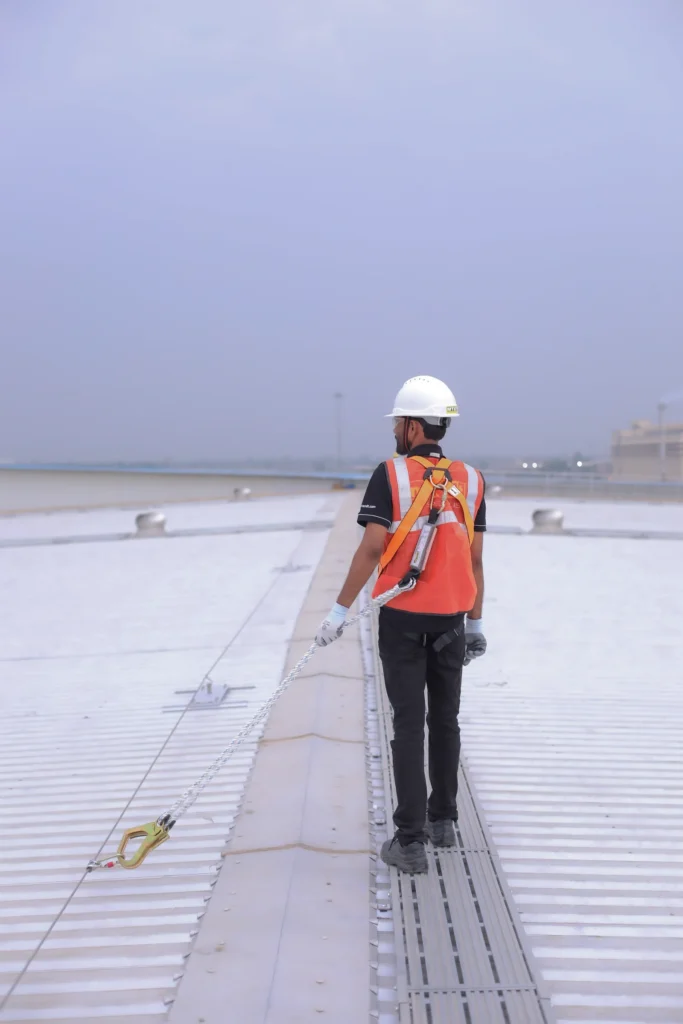
India’s Occupational Safety, Health and Working Conditions Code, 2020, in force since 21 November 2025, places general duties on employers to provide a safe workplace. In practice, that means the line must be used as designed, by trained people, and kept inspected. TsaF recommends a formal inspection at least once a year through its Annual Maintenance Check, which looks for broken strands or kinks in the cable, restores tension, and checks the energy absorber, terminations, intermediate guides, trolley movement and labels. Our fall protection inspection guide explains what each check covers.
Frequently asked questions
In seven stages: site survey, design, manufacture, fixing the roof posts, running and terminating the cable, tensioning and testing, and handover with training and documentation.
On standing seam roofs such as Snap-lock, Kalzip and Klip-lock, yes. TsaF uses clamp-on fixings that grip the seam. On trapezoidal roofs the posts are screwed into the profile and sealed.
TsaF sets tension with the TSAF-100A integrated shock absorber cum tensioner, which also absorbs energy in a fall and has an activating force of 12 kN.
Only after the line has been tested along its full length and handed over with drawings, the permitted number of users, labels and user training.
Users should check it visually before each use, and TsaF recommends a formal inspection at least once a year.
TsaF surveys, designs, manufactures, installs and maintains every horizontal life line system it supplies. Request a site assessment to plan the installation on your roof.

