
The cost of a horizontal life line system in India depends on eight things: the length of the route, the roof type and fixing method, whether the line is designed for fall restraint or fall arrest, the number of corners and obstacles, how many people will use it at once, site access, the environment and what is included at handover. Because these change from roof to roof, there is no honest per-metre price that fits every site. This guide explains each factor, what a complete quotation should contain and how to keep the cost under control without cutting safety.
Written by: Yatin Chaudhary, TsaF. Last updated: 22 October 2026.
Key takeaways
- A horizontal life line system is priced per design, not per metre, because fixings, corners, users and clearance differ on every roof.
- Route length and roof fixing usually move the price the most.
- A fall-arrest layout needs clearance checks and energy absorption, so it is engineered more closely than a restraint layout.
- Compare quotations on what is included: design, fixings, installation, testing, training, documentation and annual inspection.
- A site survey is the only reliable way to get a firm price.
What is a horizontal life line system?
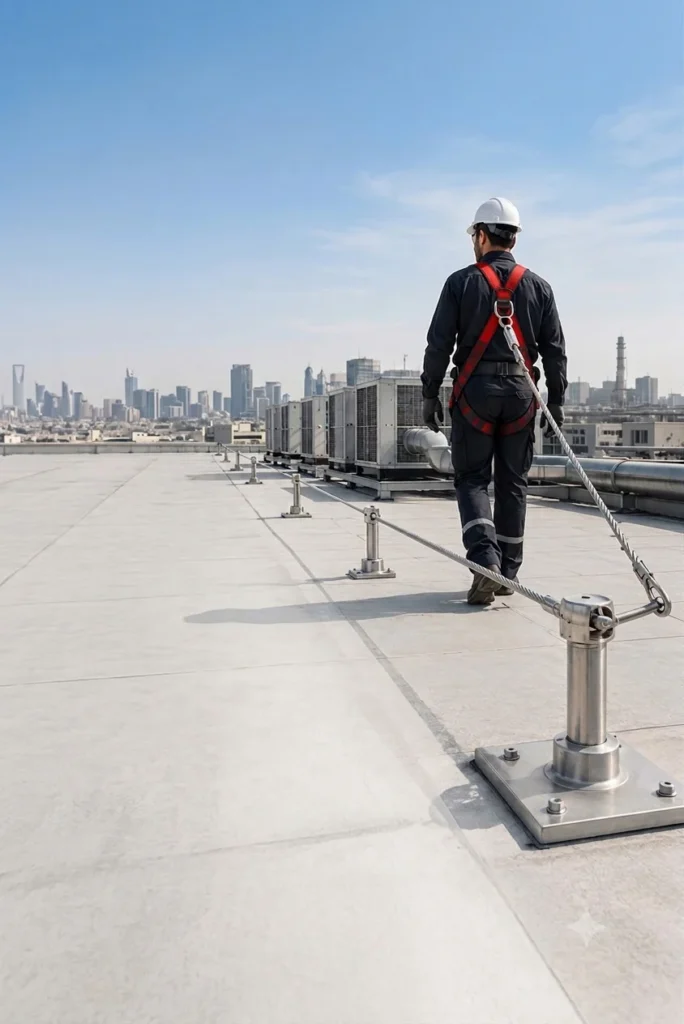
A horizontal life line system is a tensioned stainless steel cable fixed along the working routes of a roof. Workers clip on through a travelling trolley and stay connected while they move, so they never have to unclip at an anchor point. TsaF uses a Ø8 mm SS AISI 316L cable in 7×7 construction, supported by intermediate brackets typically every 8 to 12 metres, with a TSAF-100A integrated shock absorber cum tensioner at the end. The TsaF horizontal lifeline is designed in accordance with EN 795:2012 Class C, CEN/TS 16415:2013 and IS 3521 Part 8:2021.
Why is there no fixed price per metre?
Two roofs with the same route length can need very different systems. One may be a trapezoidal sheet where posts are screwed down; another may be a standing seam roof that needs clamp-on fixings. One route may be straight; another may turn six times around skylights and ventilators. One may only need to keep people away from the edge; another must arrest a fall and has limited clearance below. Each difference changes the parts list and the engineering time, which is why a per-metre figure taken from another site is a poor guide to your own.
Which 8 factors decide the cost?
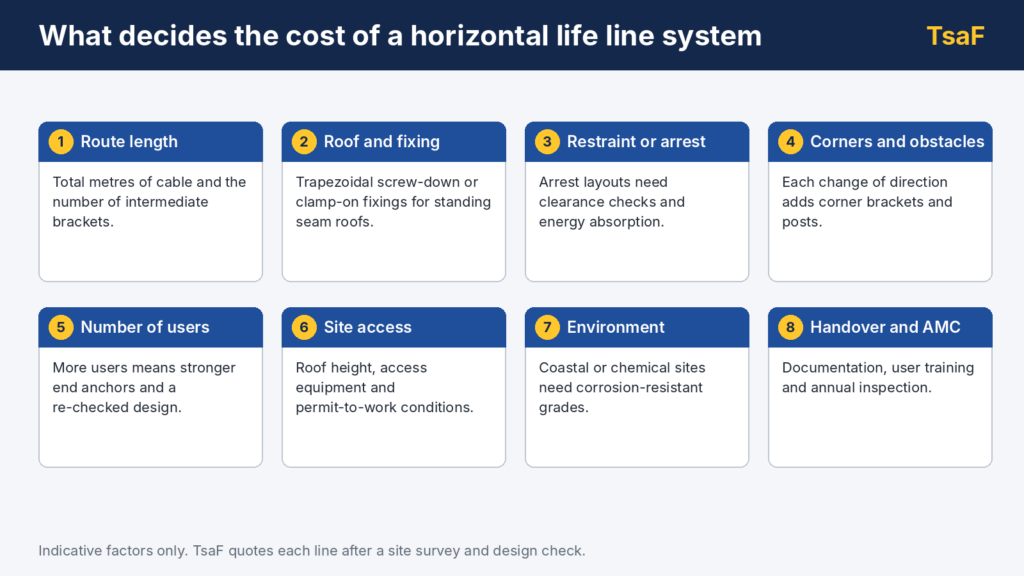
1. Route length
The total length of cable sets the number of intermediate brackets and posts. With brackets typically every 8 to 12 metres, a longer route adds hardware in a predictable way. Splitting one long route into several shorter lines can change the number of end anchors and absorbers needed.
2. Roof type and fixing method
On trapezoidal metal roofs, TsaF screws the posts down into the profile and seals them. On standing seam roofs such as Snap-lock, Kalzip and Klip-lock, clamp-on fixings grip the seam so the sheet is not pierced. The fixing type, the sheet condition and the post footprint all affect the price, and the survey confirms which applies.
3. Fall restraint or fall arrest
A restraint layout limits how far a worker can travel, so they cannot reach the edge. An arrest layout stops a fall after it has begun and needs enough clearance below the worker. Arrest layouts therefore need clearance calculations and a correctly sized energy absorber, which adds engineering work.
4. Corners and obstacles
Every change of direction needs a 90° corner bracket and often an extra post. Routes that wind around skylights, ventilators, solar panels or plant cost more than straight runs of the same length.
5. Number of users
Span lengths, intermediate spacing, the energy absorber and the end anchors are calculated for a set number of users. Designing for more people working at the same time can mean stronger end anchors and closer spacing. TsaF states the permitted number of users in the handover documents.
6. Site access and working conditions
Roof height, access equipment, permit-to-work rules, shutdown windows and working hours on a live plant all influence installation time.
7. Environment
Coastal, chemical and high-humidity sites need corrosion-resistant materials. TsaF uses SS-316 and 316L components and anodised aluminium posts for long outdoor service, and confirms the grade for your environment at design stage.
8. Handover and annual maintenance
A complete price includes testing, user training, drawings, the permitted user limit and identification labels. Many sites also add the Annual Maintenance Check, which keeps the line inspected and documented every year.
What should a horizontal lifeline quotation include?
Use this table to compare quotations on the same basis. A low price that leaves out design, testing or training is not cheaper once those items are added back.
| Item | What to look for |
|---|---|
| Site survey | Roof sheet, structure, routes, edges and access checked on site |
| Design | Layout drawing, spans, restraint or arrest, number of users |
| Materials | Cable grade and construction, post material, fixing type |
| Energy absorber | Make, rating and how it is set during installation |
| Installation | Trained team, method statement, permit compliance |
| Testing | Function check of the full line and trolley travel |
| Handover | Drawings, user limit, labels, user training |
| Inspection | Recommended interval and AMC terms |
How can you keep the cost under control without cutting safety?
- Plan routes around the tasks that are actually done on the roof, rather than protecting every metre.
- Group plant that needs regular access close to one route where the layout allows.
- Choose a restraint layout where the route and edge distance allow it.
- Share roof drawings and photos early so the design starts from accurate information.
- Plan installation during a shutdown or low-activity window to reduce access costs.
- Budget for annual inspection from the start, because a neglected line can need costly repairs.
What does TsaF need from you for an accurate quote?
To quote a horizontal lifeline accurately, our engineers need:
- Roof drawings or a sketch with approximate dimensions.
- Photos of the roof sheet, edges, skylights and plant.
- The tasks done on the roof and how often.
- The number of people who work on the roof at the same time.
- Access arrangements and any site rules for contractors.
You can then request a site assessment, and a TsaF engineer will confirm the layout and give a firm price. For component-level detail, see our horizontal lifeline design guide.
Frequently asked questions
There is no single price. The cost depends on route length, roof fixing, restraint or arrest layout, corners, number of users, access, environment and what is included at handover. TsaF quotes each horizontal life line system after a site survey.
Suppliers sometimes quote per metre, but the figure only holds for one specific roof. Corners, end anchors, absorbers and fixings do not scale with length, so the same per-metre rate rarely fits another site.
Usually, yes. A fall-arrest layout needs clearance calculations and an energy absorber sized for the design, while a restraint layout keeps people away from the edge so a fall cannot start.
It depends on the quotation. TsaF recommends a formal inspection at least once a year and offers this through its Annual Maintenance Check, which can be included or quoted separately.
Share roof drawings or photos, the tasks done on the roof and the number of users, then request a site assessment. A TsaF engineer confirms the layout on site and gives a firm price.
If you are budgeting for roof safety this year, start with a survey. TsaF designs, manufactures at its Jewar facility, installs and maintains each horizontal life line system, so one team is responsible for the price and the performance. Request a site assessment.

