
Fall protection standards tell buyers what a product must do and how labs test it. In India, facility and procurement teams usually meet a mix of Indian, European and international standards on the same datasheet. This guide explains the fall protection standards you are most likely to see, what each one covers, and how to read a standards claim before you buy. It links to our detailed standards pages rather than repeating them.
Written by: Yatin Chaudhary, TsaF. Last updated: 15 October 2026.
Key takeaways
- A product standard describes how a product is designed and tested. It does not make a whole site compliant.
- Indian buyers commonly see IS 3521, EN 795, EN 353, EN 13374, ISO 14122-3 and EN 516.
- “Designed to”, “tested to” and “certified to” mean different things, so always ask for the evidence.
- Site duties come from Indian workplace safety law, not from a product label.
Why fall protection standards matter to buyers
Fall protection standards give buyers a common reference point. For example, a standard sets the test loads, the test method and the marking a product must carry. As a result, two suppliers who quote the same standard should be describing products that passed comparable tests.
However, a standard has limits. It covers the product, not how it is installed on your roof, how your people use it, or whether rescue is planned. A certified anchor on a weak purlin is still unsafe. So treat standards as one piece of evidence, alongside a site survey, a design calculation and installation records.
Also note that no supplier can promise “full compliance” for your site from a datasheet alone. Compliance depends on the whole system and on your own procedures.
Indian fall protection standards
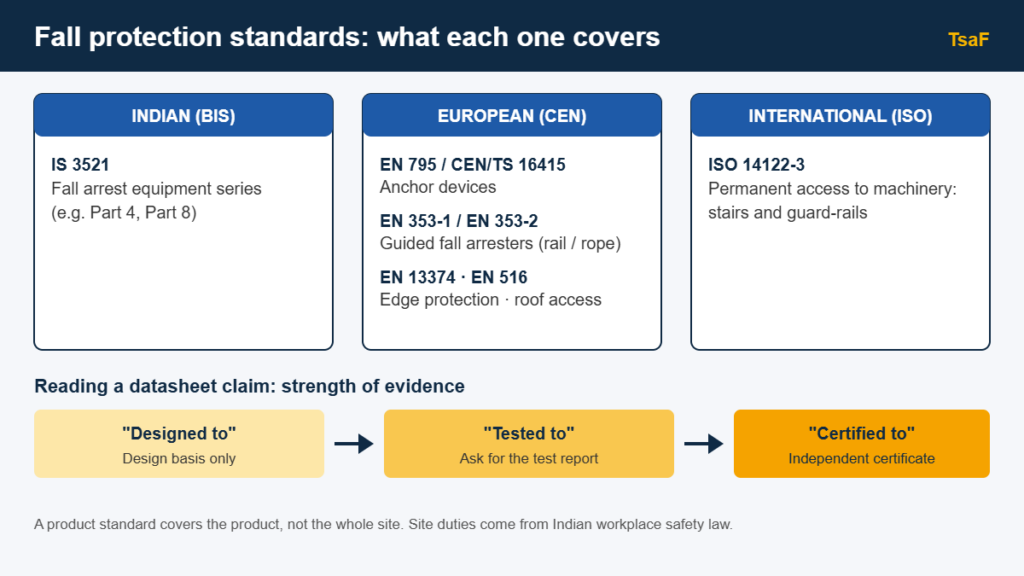
The main Indian reference is IS 3521, from the Bureau of Indian Standards. It is a multi-part series covering industrial fall arrest equipment. The parts most relevant to buyers of fall arrest and anchor devices include Part 4 and Part 8. Our page on IS 3521 Part 8 explained covers that part in detail.
In practice, many Indian sites also specify European standards. This happens because global clients, consultants and insurers often write European references into their specifications. Therefore, it is normal to see an IS reference and an EN reference on the same project.
European fall protection standards commonly referenced
Indian tenders widely use European (EN) fall protection standards. You will see these most often.
Anchor devices: EN 795 and CEN/TS 16415
EN 795 covers anchor devices for personal fall protection, including single anchor points and flexible horizontal lines. CEN/TS 16415 adds guidance for anchor devices used by more than one person at the same time. See EN 795 explained for the device types.
Guided fall arresters: EN 353-1 and EN 353-2
EN 353-1 covers guided fall arresters on a rigid anchor line, such as a rail. EN 353-2 covers guided fall arresters on a flexible anchor line, such as a wire rope. These are the standards behind most ladder fall protection. For a full comparison, read EN 353-1 vs EN 353-2, or see how they apply to a vertical lifeline system.
Edge protection and access: EN 13374, ISO 14122-3 and EN 516
EN 13374 covers temporary edge protection systems. ISO 14122-3 covers permanent means of access to machinery, including guard-rails. EN 516 covers roof access installations such as walkways and steps. Suppliers often reference these fall protection standards for barricades and rooftop walkways.
How to read fall protection standards on a datasheet
Datasheets use three phrases that sound alike but carry different weight. First, “designed to” or “designed in accordance with” means the engineer used the standard as a design basis. It does not by itself mean the product was tested. Next, “tested to” means someone tested the product against the standard. You should ask who did the test and for the report. Finally, “certified to” means an independent body checked the product, often through a type examination, and issued a certificate.
Before you accept any claim, ask these questions:
- Which edition of the standard does the claim refer to, for example EN 795:2012?
- Which product type or class does the claim cover?
- Who issued the test report or certificate, and can you see it?
- Does the certificate match the exact configuration you are buying?
- How many users, and in what direction of loading, did the test cover?
If a supplier cannot answer these clearly, treat the claim with caution.
Indian regulations and site responsibilities
Product standards sit alongside, not in place of, the law. In India, employers have general duties to provide safe workplaces, safe means of access and protection for work at height. These duties come from national labour and occupational safety law, including the Occupational Safety, Health and Working Conditions Code, 2020, and from state rules. The Directorate General Factory Advice Service and Labour Institutes publishes guidance for factories.
In short, the employer remains responsible for risk assessment, training, inspection and rescue. Our guide to rooftop fall protection standards in India explains how these duties apply on roofs.
Sources and further reading
- Bureau of Indian Standards, publisher of IS 3521.
- CEN-CENELEC, publisher of EN standards such as EN 795 and EN 353.
- ISO, publisher of ISO 14122-3.
- TsaF certifications for our product certificates.
Frequently asked questions
Indian buyers commonly see IS 3521 from the Bureau of Indian Standards, together with European standards such as EN 795, EN 353-1, EN 353-2, EN 13374 and EN 516, and ISO 14122-3. Which ones apply depends on the product type and on your client or project specification.
Many Indian projects specify EN 795 for anchor devices, especially where global clients, consultants or insurers write European standards into the specification. Always check what your own project or client requires.
EN 353-1 covers guided fall arresters on a rigid anchor line, such as a rail. EN 353-2 covers guided fall arresters on a flexible anchor line, such as a wire rope.
No. A certificate covers the product. Site compliance also depends on the design, installation, fixing to the structure, training, inspection and rescue planning.
Ask which edition and product type the claim covers, who issued the test report or certificate, whether it matches your exact configuration, and how many users it was tested for.
Next step
Standards are only one part of choosing the right system. A TsaF engineer can review your roof, your work at height tasks and the fall protection standards your client specifies. Request a site assessment to get a clear, documented recommendation.

